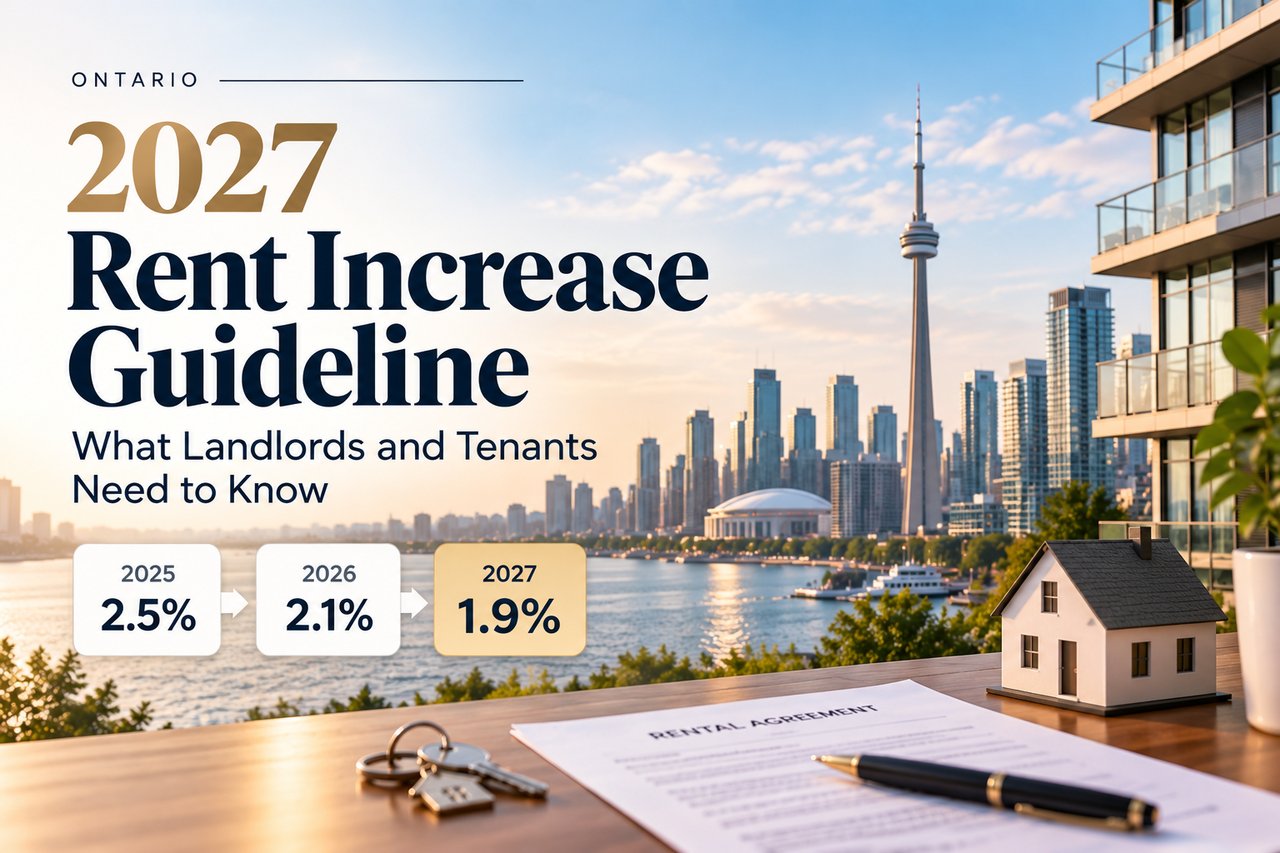
Ontario has announced its 2027 rent increase guideline of 1.9%, down from 2.1% in 2026 and 2.5% in 2025. This marks the second consecutive year of a lower annual guideline and is an important update for landlords and tenants across the province.
However, the 1.9% guideline does not apply to every rental property, nor does it mean landlords can automatically increase rent at the beginning of the year.
Understanding Ontario's rent control rules, exemptions, and notice requirements is essential for navigating rental agreements and making informed decisions.
Why Is the 2027 Guideline 1.9%?
Ontario's annual rent increase guideline is calculated using the Ontario Consumer Price Index (CPI), which measures changes in the prices of everyday goods and services.
The province uses CPI data from June through May to establish the following year's guideline. Under Ontario's Residential Tenancies Act, the annual guideline is capped at 2.5%.
Over the past several years, Ontario's rent increase guideline has changed as follows:
Year | Rent Increase Guideline |
|---|---|
2023 | 2.5% |
2024 | 2.5% |
2025 | 2.5% |
2026 | 2.1% |
2027 | 1.9% |
The declining guideline reflects a moderation in the inflation rate used to calculate the permitted annual rent increase.
Importantly, a lower rent increase guideline does not necessarily mean rental prices are falling. It simply means the maximum annual increase permitted for most rent-controlled tenancies is lower than in previous years.
Which Rental Properties Are Subject to Rent Control?
One of the most important factors in determining whether the guideline applies is when a property was first occupied for residential purposes.
Generally, residential rental units first occupied on or before November 15, 2018, are subject to Ontario's annual rent increase guideline.
This includes many condominiums, detached homes, townhouses, and apartments.
For example, consider a condominium in Mississauga that was built and occupied in 2015. Even if the current owner purchased the property in 2026, the unit would generally remain subject to rent control.
By contrast, a newly constructed condominium first occupied for residential purposes in 2022 would generally be exempt from the annual guideline.
Certain newly created rental units and additions to existing buildings may also qualify for exemptions, depending on their circumstances.
An important distinction: A property's purchase date does not determine whether it is rent-controlled. What matters is its residential occupancy history and whether it qualifies for an exemption under Ontario's rental regulations.
Landlords should maintain appropriate documentation supporting any claimed exemption, particularly for newly constructed or converted rental units.
What Happens When a Tenant Moves Out?
A common misconception is that a rent-controlled property must always remain at the same rental rate, with increases limited to the annual guideline.
In reality, Ontario's rent control system makes an important distinction between an existing tenancy and a new tenancy.
When an existing tenancy legally ends and a new tenant enters into a new rental agreement, the landlord and incoming tenant can generally negotiate a new starting rent.
For example, if a tenant moves out of a rent-controlled condominium, the landlord is generally not required to calculate the next tenant's starting rent using the previous rent plus 1.9%.
However, once the new tenancy begins, future annual rent increases will generally remain subject to the applicable guideline if the property itself is rent-controlled.
This distinction is particularly important for landlords evaluating their rental property plans and for tenants considering whether to renew their current lease or move to another property.
It is also important to remember that a lease renewal or continuation with the same tenant is not the same as a genuine change of tenancy.
When Can a Landlord Increase Rent?
Even when a rental property is exempt from the annual rent increase guideline, landlords must generally comply with Ontario's timing and notice requirements.
The 12-Month Rule
A landlord must generally wait at least 12 months after the beginning of a tenancy or the last lawful rent increase before increasing rent again.
For example, if a tenant's last lawful rent increase took effect on September 1, 2026, the next regular increase generally cannot take effect before September 1, 2027.
The 90-Day Notice Requirement
Landlords must generally provide tenants with at least 90 days' written notice before a rent increase takes effect.
The notice must comply with Ontario's Residential Tenancies Act and applicable Landlord and Tenant Board requirements.
A fixed-term lease reaching its expiry date does not automatically allow a landlord to establish a new rental rate. Most residential tenancies continue on a month-to-month basis unless they are lawfully terminated.
What Should Landlords Consider Before 2027?
For landlords, the new guideline provides an opportunity to review rental property records and ensure future rent adjustments are handled correctly.
Before issuing a rent increase notice, landlords should confirm whether their property is subject to rent control, review the date of the last lawful rent increase, and ensure all applicable timing and notice requirements are met.
Owners of newer properties should also maintain reliable documentation establishing when their rental units were first occupied for residential purposes.
For tenants, understanding whether a property is rent-controlled can help clarify what rent increases may be permitted and when they can legally take effect.
Clear documentation and a shared understanding of rights and responsibilities can help both parties avoid unnecessary misunderstandings and disputes.
Final Thoughts
Ontario's 1.9% rent increase guideline for 2027 continues the downward trend seen over the past two years.
However, the percentage alone does not tell the whole story.
Whether a property is subject to rent control, whether a tenancy is continuing or beginning, and whether the proper notice requirements have been followed can all affect how the guideline applies.
For landlords and tenants across the Greater Toronto Area, understanding these distinctions is an important part of navigating Ontario's rental market with confidence.
At The Fisher Group, we believe informed real estate decisions begin with understanding the rules that affect your property. Whether you're preparing to lease an investment property or exploring your next move, our team is here to help you navigate the process.