2025 GTA Real Estate Market Annual Review: Sales Hit a 10-Year Low as Prices Adjusted 4.7%
The Greater Toronto Area (GTA) real estate market in 2025 marked one of the most significant reset points of the past decade. According to Toronto Regional Real Estate Board (TRREB) data, annual home sales fell to their lowest level in more than 10 years, while average prices declined by approximately 4.7% year-over-year.
Rather than signaling distress, these figures reflect a market that has moved decisively away from the excesses of the pandemic era and into a phase of normalization.
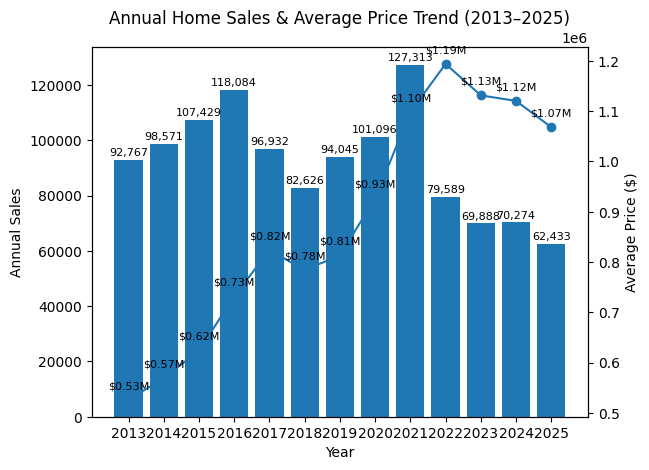
GTA Annual Home Sales & Average Price Trend (2013-2025):
Sales Activity: The Lowest Level in a Decade
Total GTA home sales in 2025 reached 62,433 transactions, down by 11.2% compared to 2024, also the lowest annual total since the mid-2010s. Compared to the 2021 peak—when sales surged past 127,000—today’s activity represents a dramatic slowdown.
However, the decline in sales was driven less by a collapse in demand and more by structural and economic factors:
Higher borrowing costs limited purchasing power
Buyers became more cautious and selective
Sellers delayed listings rather than accept steep discounts
Viewed historically, 2025 sales volumes closely resemble pre-pandemic norms, underscoring how unusual the last few years truly were.
Price Trends: A 4.7% Adjustment, Not a Breakdown
While sales activity weakened significantly, prices adjusted at a far more measured pace. The average GTA home price declined by approximately 4.7% in 2025, settling near $1.07 million.
This moderation marked a clear departure from the rapid appreciation seen during 2020–2022—but importantly, prices remained well above long-term historical levels.
The disconnect between falling sales and relatively resilient pricing highlights a key feature of the GTA market:
supply constraints continue to provide a strong price floor, even during periods of reduced activity.
Many homeowners opted to wait rather than sell into a softer market, limiting downward pressure on prices.
Inventory and Market Balance
With sales slowing, active listings remained elevated throughout much of 2025. This shift restored negotiating power to buyers and reduced the urgency that dominated previous market cycles.
At the same time, pricing discipline became critical. Homes that were accurately priced and professionally marketed continued to transact, while overpriced listings often faced extended time on market.
The result was a market that rewarded preparation, realism, and strategy—rather than speculation.
What This Meant for Buyers
For buyers, 2025 offered conditions not seen in years:
Less competition
More inventory choice
Increased leverage on price and terms
While prices did not dramatically fall, the calmer environment allowed buyers to make decisions based on value rather than urgency.
Internal link suggestion: Buyer Resources / GTA Market Insights
What This Meant for Sellers
For sellers, 2025 reinforced an important lesson: the market no longer absorbs unrealistic pricing.
Success depended on:
Accurate valuation
Strong presentation
Clear positioning within the competitive landscape
Homes aligned with market reality continued to sell, even as overall activity slowed.
Internal link suggestion: Seller Services / Home Valuation
Looking Ahead
TRREB has indicated that the price adjustment and reduced activity seen in 2025 have helped restore balance to the market, potentially setting the stage for gradual recovery as borrowing conditions improve.
Rather than a rapid rebound, the data suggests a market moving toward stability first, growth second.
The Fisher Group Perspective
At The Fisher Group, we see 2025 as a necessary reset. Sales activity reached a decade low, prices corrected modestly, and expectations on both sides of the transaction recalibrated.
For buyers, sellers, and long-term homeowners, this environment rewards insight, patience, and local expertise more than timing the market.