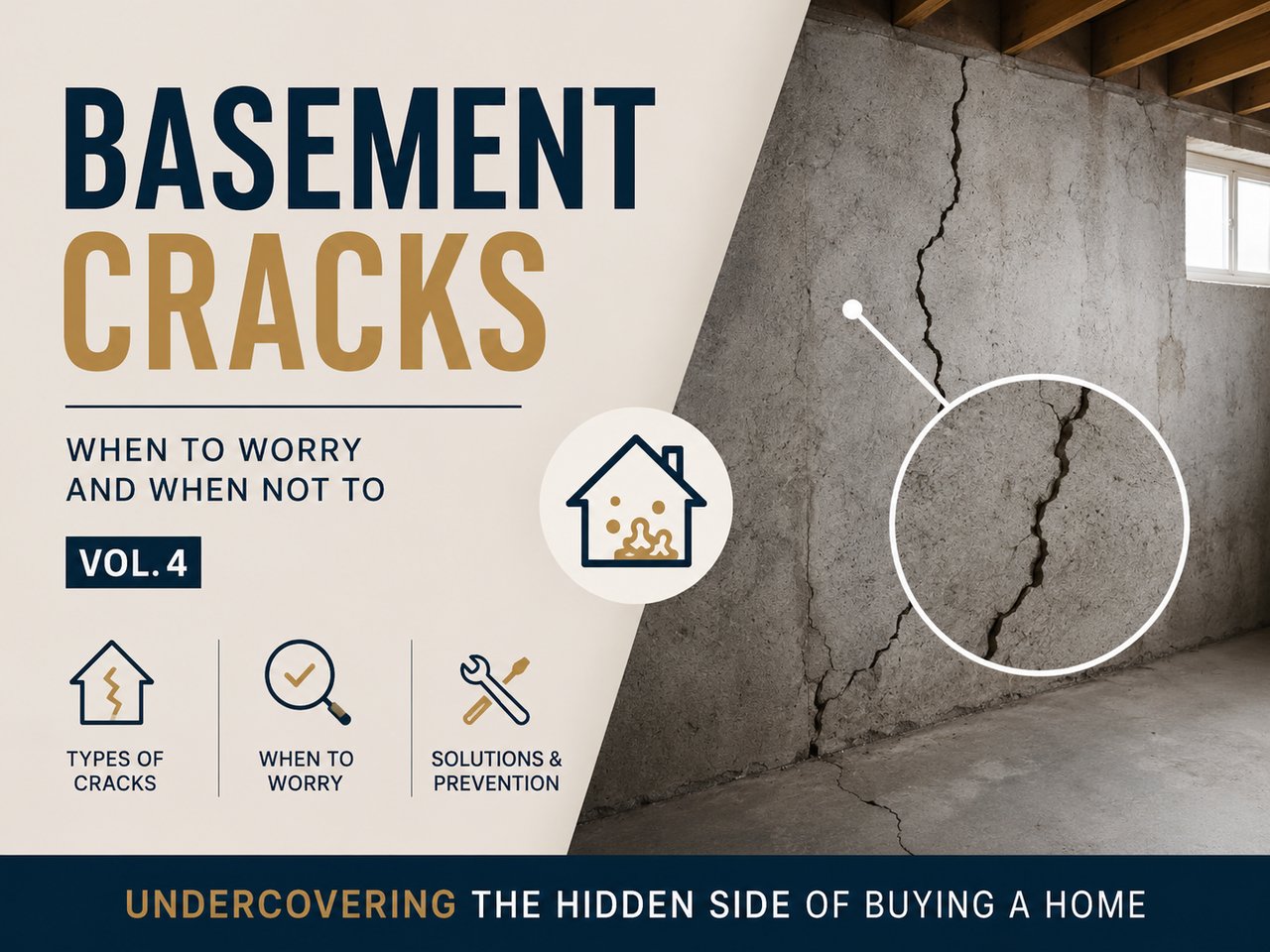
When touring a home, would you immediately rule it out if you noticed a crack in the basement?
For many buyers, basement cracks feel like a red flag.
But the reality is: in Canada, foundation cracks are far more common than most people think.
In fact, for many older homes, finding absolutely no cracks at all can sometimes be less common than finding a few minor ones.
Before assuming the worst, it’s important to understand what type of crack you’re looking at—and what it actually means.
Why Basement Cracks Are So Common in Canada
Concrete naturally expands and contracts over time.
Combine that with Canada’s climate—cold winters, warm summers, and repeated freeze-thaw cycles—and the soil beneath homes constantly shifts and moves.
Over years or decades, it’s normal for some stress to show up in foundation walls.
Small hairline cracks can simply be part of a home aging naturally.
That doesn’t automatically mean the foundation is failing.
Not All Cracks Mean the Same Thing
This is where context matters.
Vertical Hairline Cracks
Vertical cracks are among the most common types found in basement walls.
They’re often caused by normal concrete shrinkage or natural settling.
If the crack is:
- narrow,
- stable over time,
- and not allowing moisture inside,
it may not be considered a major concern.
Horizontal, Diagonal, or Expanding Cracks
These deserve more attention.
If cracks appear:
- horizontally,
- diagonally,
- unusually wide,
- accompanied by water intrusion,
- paired with uneven floors,
- or doors that no longer close properly,
those may indicate something more significant.
Potential causes can include:
- uneven foundation pressure,
- soil settlement,
- drainage issues,
- or structural movement.
These situations often require closer investigation.
Can Foundation Cracks Be Repaired?
In most cases—yes.
The repair method depends on the underlying cause.
Minor Cracks or Small Water Leaks
One common repair solution is high-pressure crack injection, where specialized sealant material is injected into the crack to create a waterproof barrier.
For many minor situations, repairs can be relatively straightforward and cost-effective.
More Significant Water Issues
If moisture intrusion becomes more severe, exterior excavation and rebuilding the waterproofing and drainage system may be required.
Structural Movement or Foundation Settlement
If movement affects structural performance, more extensive foundation stabilization or engineering solutions may become necessary.
The scope—and cost—can increase significantly at this stage.
Don’t Let Cracks Scare You—Understand Them
Seeing a basement crack shouldn’t automatically end your interest in a property.
The real question isn’t:
“Does the house have cracks?”
It’s:
“Why did the cracks happen?”
Some are simply signs of age.
Others may be early warning signals.
That’s why home inspections matter.
An experienced home inspector can often help determine whether what you’re seeing is normal wear—or whether further review by a structural engineer is worth considering.
Final Thoughts
Basement cracks are common in Canadian homes.
Most are manageable.
Some require attention.
Very few can be judged accurately from appearance alone.
If you’re buying, don’t panic—and don’t ignore them either.
Ask questions, understand the cause, and make decisions based on facts instead of fear.
Thinking about buying or selling in the GTA? Contact The Fisher Group today to discuss your next move.