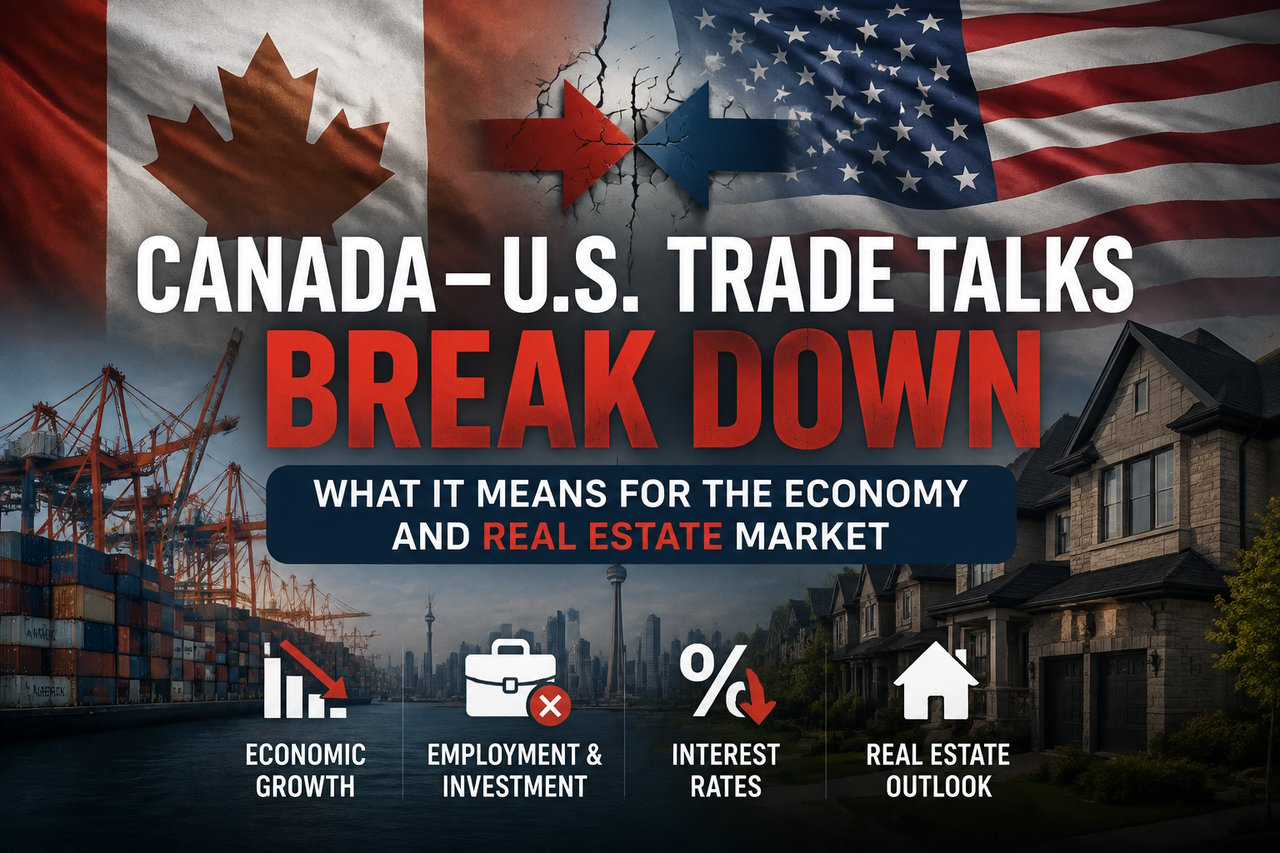
The latest Canada-U.S. trade negotiations have reached another breaking point.
At first glance, many people may simply see this as another headline about tariffs.
But the issue goes much deeper than tariffs on steel, aluminum, automobiles, or other individual industries.
What is happening now may represent a broader shift in one of Canada’s most important economic relationships — the long-standing integration between the Canadian and U.S. economies.
For the next few years, this could have significant implications for Canada’s economic growth, employment, interest rates, consumer confidence, and ultimately the real estate market.
So what exactly happened, and what could it mean for homeowners, buyers, sellers, and investors?
Why This Trade Negotiation Matters
Canada and the United States have one of the closest economic relationships in the world.
For decades, Canadian industries have been deeply connected to the U.S. market. Energy, automobiles, steel, aluminum, agriculture, lumber, and manufacturing products all rely heavily on cross-border trade.
In 2025, approximately 71.7% of Canada’s merchandise exports were shipped to the United States, making the U.S. Canada’s largest export market by a significant margin.
This means the U.S. is not simply another trading partner for Canada — it is a major part of Canada’s economic foundation.
However, the relationship has entered a new phase.
Historically, Canada’s approach was based on the idea that economic integration benefited both countries, creating strong incentives to maintain open trade.
Today, the U.S. approach has shifted toward a stronger focus on domestic production and using access to the American market as leverage during negotiations.
Canadian Prime Minister Mark Carney summarized this change by stating:
“America has changed.”
The message is clear: Canada may need to adapt to a different economic environment moving forward.
Why Did the Negotiations Fail?
The two sides appeared close to reaching an agreement before talks broke down.
Discussions reportedly included possible reductions in tariffs affecting automobiles, steel, aluminum, and other industries.
However, the final agreement failed to materialize because the two countries could not reach common ground on several major issues.
1. The Automotive Industry
The automotive sector is one of the most important industries in Ontario.
Over decades, Canada and the U.S. have developed highly integrated supply chains.
A vehicle may involve components manufactured in multiple locations across North America before final assembly and distribution.
Because of this integration, automotive tariffs do not simply affect one company or one product — they can impact an entire network of suppliers, manufacturers, and workers.
Canada wanted stronger tariff relief for its automotive industry, while the U.S. pushed for more domestic production and sourcing requirements.
The two sides were unable to find a long-term solution that both governments could accept.
2. Strategic Industries: Steel, Aluminum, and Manufacturing
Industries such as steel, aluminum, and lumber are also highly exposed to trade uncertainty.
Canadian companies depend heavily on predictable access to the U.S. market.
When businesses cannot predict whether their products will face 0%, 25%, or 50% tariffs in the future, investment decisions become more difficult.
A company may delay expanding a factory, hiring workers, or purchasing new equipment simply because the future environment is unclear.
The biggest concern is not only the cost of tariffs today.
It is the possibility that uncertainty reduces future investment.
3. Economic Independence and Policy Control
The third issue is broader: Canada’s ability to control its own economic policies.
Canadian officials indicated that some U.S. requests went beyond traditional tariff discussions and touched on areas related to Canada’s independent policy decisions.
Canada was willing to negotiate trade issues, but not at the expense of losing control over future economic relationships and domestic priorities.
Ultimately, the disagreement became about more than trade numbers — it became about how the two countries define their future relationship.
What Happens After the Breakdown?
Following the failed negotiations, the United States moved forward with additional tariffs affecting approximately $28 billion worth of Canadian goods.
Canada has also announced plans for equivalent retaliatory measures.
This means the relationship has moved beyond a simple negotiation dispute and into a more uncertain period of trade tension.
The economic impact will likely depend on how long this uncertainty continues.
Impact on the Canadian Economy
1. Businesses May Become More Cautious
One of the biggest risks is not the immediate cost of tariffs.
It is the impact on business confidence.
When companies are uncertain about future trade conditions, they often delay investment decisions.
A manufacturer deciding whether to invest millions of dollars into a new facility may hesitate if the rules could change within the next few years.
This uncertainty can affect:
- Business expansion
- Hiring decisions
- Capital investment
- Economic growth
The Bank of Canada has already identified trade uncertainty as a significant risk to the Canadian economy.
2. Employment and Consumer Confidence
Ontario may be particularly sensitive because of its strong connection to manufacturing and automotive industries.
Communities across the Greater Toronto Area, including Oakville, Burlington, Mississauga, Hamilton, and Windsor, are connected directly or indirectly to these industries.
Economic weakness does not always appear immediately through large layoffs.
Often, the first signs are:
- Fewer job openings
- Reduced overtime
- Hiring freezes
- Delayed expansion plans
Over time, these factors influence consumer confidence.
And real estate is one of the industries most affected by consumer confidence.
3. Interest Rates: Will Trade Tensions Lead to Lower Rates?
A weaker economy could increase pressure on the Bank of Canada to reduce interest rates.
However, the situation is complicated.
Trade restrictions can also increase costs for imported goods, creating inflationary pressure.
This creates a difficult situation:
A weaker economy may require lower rates, but higher prices may limit how aggressively rates can be reduced.
The future direction of interest rates will depend on the balance between:
- Economic growth
- Employment
- Inflation
- Consumer spending
What Does This Mean for Canadian Real Estate?
Trade tensions do not directly determine home prices.
A new tariff announcement does not immediately translate into a significant change in housing prices.
Real estate is influenced by several major factors:
- Employment
- Consumer confidence
- Interest rates
- Housing supply
- Construction costs
Short-Term Impact: Buyer Confidence May Slow
The most immediate impact may be confidence.
Many buyers do not delay purchasing a home because of a small change in interest rates.
They delay because they are uncertain about the future.
Questions such as:
“Will my job remain stable?”
“Will my industry be affected?”
“Should I wait another six months?”
can have a significant impact on market activity.
Therefore, trade uncertainty may affect transaction volume before it affects prices.
Why Ontario and the GTA Deserve Attention
Ontario has stronger exposure to U.S. trade than many other provinces.
For markets such as Oakville, Burlington, Mississauga, Milton, and the surrounding GTA, key indicators to watch include:
- Manufacturing employment
- Automotive investment
- Business hiring
- Consumer confidence
The GTA housing market had already started showing signs of stabilization.
However, renewed economic uncertainty could slow the recovery process by making buyers more cautious.
A Potential Long-Term Impact: Higher Construction Costs
One factor that is often overlooked is the impact on housing supply.
Trade restrictions and tariffs can increase the cost of:
- Building materials
- Equipment
- Imported products
- Construction inputs
Canada already faces significant challenges in housing development:
- High land costs
- Expensive labour
- Development charges
- Lengthy approval timelines
Higher construction costs could make new housing even more expensive to build.
This creates an interesting situation:
Economic uncertainty may weaken housing demand in the short term, while higher construction costs may continue to put upward pressure on housing prices over the long term.
The Bigger Question: Canada’s Economic Direction
The most important takeaway from this situation may not be the tariffs themselves.
It is the possibility that Canada is reconsidering its long-standing dependence on the U.S. market.
Canada has already been exploring opportunities to diversify trade relationships, strengthen infrastructure, and expand access to markets beyond the United States.
However, economic transitions take time.
Supply chains that have been built over decades cannot be replaced overnight.
The next few years may represent a period of adjustment for the Canadian economy.
Our Perspective
The breakdown in Canada-U.S. trade negotiations is not simply a tariff dispute.
It represents a potential shift in one of Canada’s most important economic relationships.
For the economy, the biggest risk is not only the direct cost of tariffs, but the impact on business investment and consumer confidence.
For real estate, the biggest concern is not whether home prices will immediately rise or fall.
The more important questions are:
- How will employment change?
- Where will interest rates move?
- How will consumer confidence evolve?
- How will construction costs be affected?
Real estate markets are ultimately driven by fundamentals.
Data tells us where we have been. Trends help us understand where we are going. Experience helps us make better decisions along the way.
The Fisher Group will continue monitoring how these economic changes may influence the Greater Toronto Area real estate market.