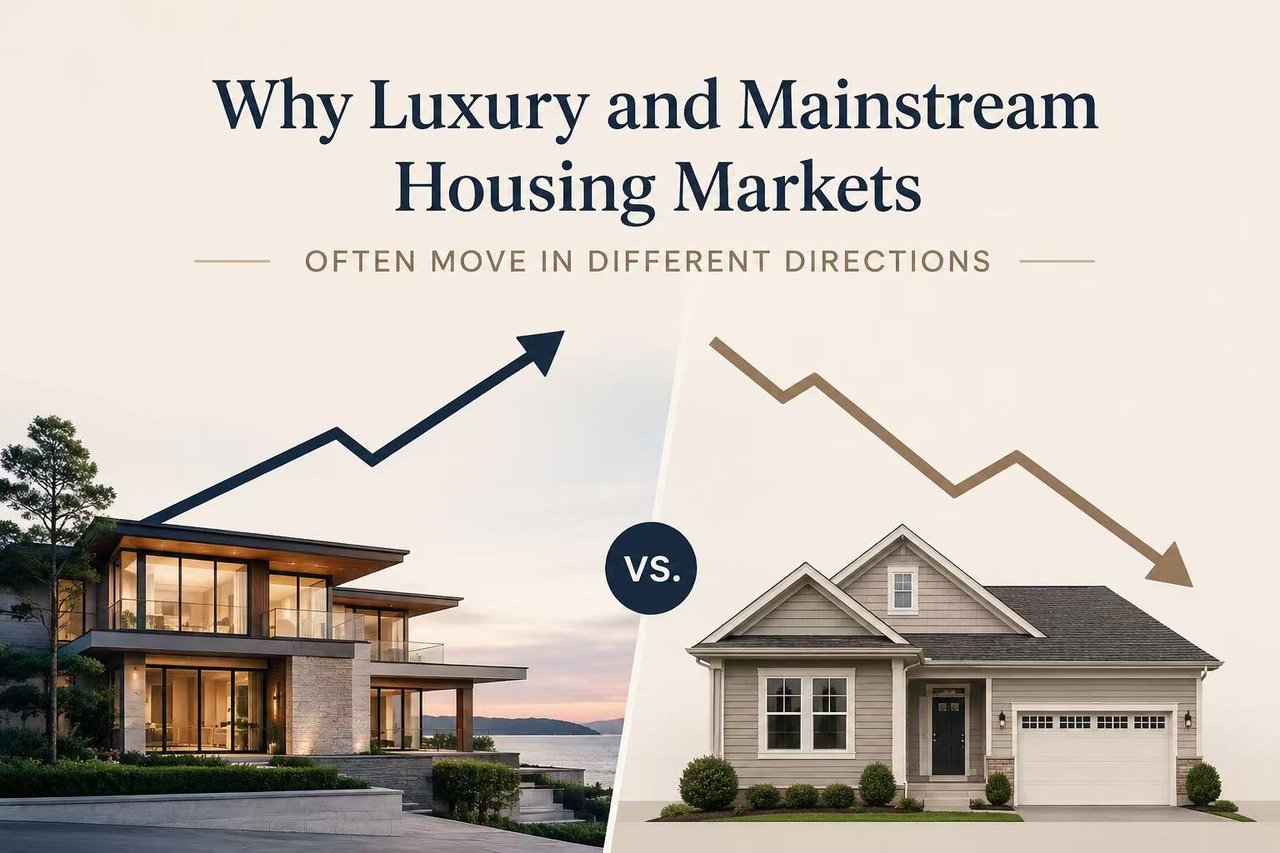
It is common to hear people refer to "the real estate market" as though it were a single, unified system. In reality, residential real estate is composed of multiple submarkets, each influenced by different buyer profiles, financing structures, and economic drivers.
This distinction becomes particularly evident when comparing luxury properties with the broader residential market. While both are affected by interest rates, economic growth, and consumer confidence, they often follow very different trajectories throughout the same market cycle.
Different Buyers, Different Decision-Making
The most significant difference lies in the characteristics of the buyer.
For mainstream housing, affordability remains the primary consideration. Purchasing decisions are heavily influenced by mortgage qualification, borrowing costs, monthly cash flow, and household income. Even a modest increase in interest rates can meaningfully reduce purchasing power, causing demand to soften relatively quickly.
Luxury buyers, however, typically approach acquisitions from a different perspective. While financing may still be utilized, purchasing decisions are less dependent on monthly affordability and more closely tied to long-term wealth preservation, portfolio diversification, lifestyle preferences, and family planning.
As a result, the luxury segment tends to be less sensitive to short-term fluctuations in borrowing costs.
Demand Is Not Equally Elastic
From an economic perspective, the two markets exhibit different levels of demand elasticity.
Demand within the mainstream market responds more readily to changes in financing conditions. As borrowing becomes more expensive, a larger portion of potential buyers delay purchases or adjust their budgets.
Luxury demand is generally more inelastic. Buyers at this level often possess greater financial flexibility and are less constrained by financing costs. Their purchasing decisions are more likely to be driven by asset quality than by changes in mortgage rates alone.
This helps explain why luxury transactions may continue even during periods when activity in lower price segments slows considerably.
Scarcity Creates Pricing Resilience
Supply characteristics further distinguish the two markets.
Mainstream homes typically have numerous substitutes. Buyers can compare multiple neighbourhoods, housing types, or municipalities within a similar budget, creating greater competitive pressure on pricing.
Luxury properties, however, derive much of their value from scarcity.
Premium waterfront locations, large private lots, prestigious school districts, mature neighbourhoods, architectural significance, and unobstructed views are finite assets that cannot be replicated through new construction.
When value is largely driven by scarcity rather than replacement cost, pricing tends to be more resilient throughout market cycles.
Looking Beyond the Headlines
Market commentary often focuses on broad indicators such as average home prices or overall sales activity. While these metrics provide useful context, they rarely capture the dynamics occurring within individual market segments.
It is entirely possible for entry-level housing to experience declining sales while luxury transactions remain relatively active. Conversely, higher-end properties may slow first during periods of economic uncertainty while more affordable homes recover sooner as financing conditions improve.
For buyers, sellers, and investors alike, understanding which segment of the market is changing—and why—is often more valuable than focusing solely on aggregate market statistics.
Final Thoughts
Luxury real estate and the mainstream housing market operate within the same economy, but they are driven by different fundamentals.
Affordability, financing accessibility, buyer motivation, and supply constraints all influence these segments in distinct ways. As a result, they rarely move in perfect synchrony.
Rather than viewing real estate as a single market, it is more accurate to think of it as a collection of interconnected markets, each responding differently to economic conditions. Recognizing these differences leads to a more informed interpretation of market trends and ultimately supports better real estate decisions.